USD to JPY: The Weak-Yen Windfall and What Your Dollars Really Buy
Convert USD to JPY today and one dollar comes back as roughly ¥155 — about 41% more yen than the same dollar bought in 2021, and more than at almost any point since 1990. Here's the part most rate trackers miss: because Japanese prices have barely moved in three decades, that windfall is real buying power, not a number that local inflation quietly eats. This page covers the multiply-direction math, why the discount holds up in actual shops, what a five-yen move does to a large invoice, and the intervention days when the rate can drop ¥5 in an afternoon.
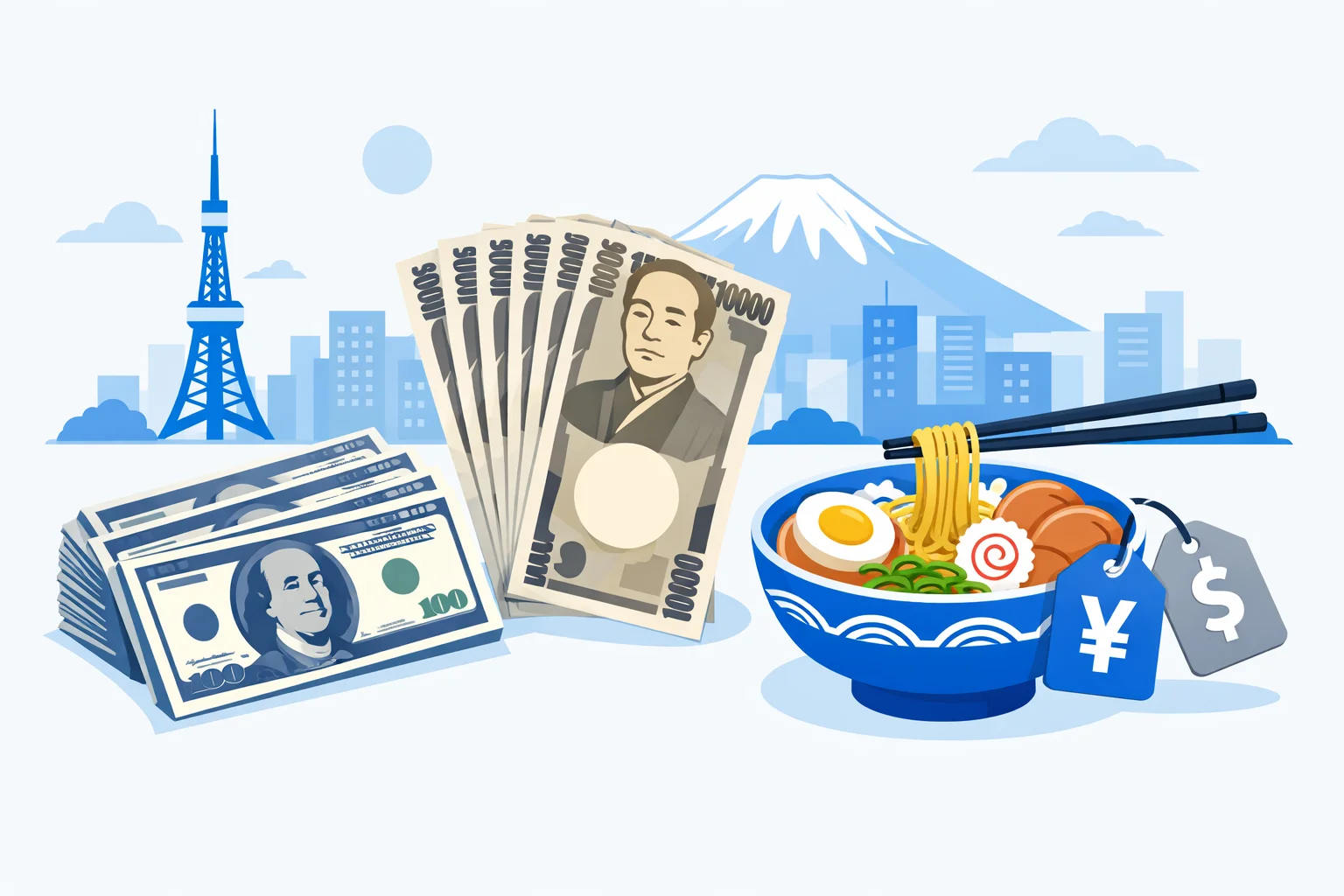
The Multiply Direction: $1 = ¥155
Dollars to yen means multiplying by the rate. At ¥155 per dollar, $100 × 155 = ¥15,500, and $1,000 becomes ¥155,000. The sanity check is simple: yen amounts should look big. A coffee costs hundreds of yen and a hotel night costs thousands, so if your “converted yen” figure is smaller than the dollar figure you started with, you divided by mistake — $100 ÷ 155 gives 0.65, a number that means nothing in either currency.
For head math, split the multiplier: ×155 is ×150 plus ×5. Take $40 — that's 6,000 plus 200, or ¥6,200 exactly. Most people just use ×150 and accept being about 3% low. One more quirk worth knowing: the yen has no cents. There are no decimals on Japanese price tags, so the converter rounds to whole yen. Going the other direction — standing in a Tokyo shop trying to read a ¥3,980 tag in dollars — is a different skill with its own shortcuts, covered in our yen to dollars converter.
Why Does a Dollar Buy 41% More Japan Than in 2021?
In 2021 the dollar averaged about ¥110. By 2024 it had pushed past ¥155, and it has stayed in that neighborhood since. Run the numbers on a $3,000 trip budget: ¥330,000 then, ¥465,000 now — an extra ¥135,000 for identical dollars. The short version of why: the US Federal Reserve pays roughly 4.5% on dollars while the Bank of Japan pays about 0.5% on yen, and money flows toward yield. The full mechanics — the carry trade, the feedback loops, the day in August 2024 when it all snapped — are the territory of our JPY to USD converter, which looks at the same pair through a trader's eyes.
From the dollar side, the yen matters more than most Americans realize: it carries a 13.6% weight in the US Dollar Index, second only to the euro's 57.6%. When headlines say “the dollar is strong,” a good chunk of that strength is the yen leg. The effect on the ground has been dramatic — Japan logged a record 36.9 million foreign visitors in 2024, blowing past the pre-pandemic peak of 31.9 million, and the cheap yen is the single biggest reason.
Japan's Missing Inflation Makes the Discount Real
A strong currency usually comes with a catch. Convert dollars into a currency that's inflating fast and you get more units that each buy less — the extra zeros are an illusion. Japan is the great exception. Between 1995 and 2021, Japan's consumer price index rose about 4% in total. Not per year — in total, across 26 years. US prices rose roughly 80% over the same stretch, per World Bank inflation data.
That means the yen you receive at today's rate buys nearly the same goods yen bought decades ago. A neighborhood ramen bowl that cost ¥800 in 2000 might run ¥950 now; an $8 American burrito from 2000 is $14 today. So when the rate hands you 41% more yen than it did in 2021, you're not being compensated for local price rises — you're pocketing almost the entire gain as real purchasing power. Economists spent years calling this Japan's problem (the “lost decades” of flat wages and deflation). For a dollar-holder, it's the other side of the same coin: a developed country where your money goes further than the exchange rate alone suggests.
The Same Latte, Two Price Tags
Put concrete items side by side and the gap stops being abstract. A Big Mac runs about ¥480 in Japan — $3.10 at ¥155 — versus $5.79 in the US, a 46% discount on the identical burger. The Economist has tracked exactly this comparison since 1986 via its Big Mac Index, and Japan now sits among the cheapest developed countries on it. A proper bowl of ramen is ¥950 (about $6.13) against $16 at a US ramen shop. A business-hotel night: ¥9,500, or $61, for a room that would be $150 in an American city. Tokyo's subway base fare is ¥180 — $1.16 versus New York's $2.90.
The honest caveat: the discount isn't uniform. Hotel rates in tourist-heavy districts of Tokyo and Kyoto have jumped 30–40% in yen terms since 2019 — the one corner of Japan where the visitor boom created real inflation — and luxury gift fruit (¥10,000 melons are not a myth) plays by its own rules. Everyday food, transit, and mid-tier lodging still carry the full weak-yen discount. The parity table in the converter above recomputes the whole comparison at the live rate, so you can watch the discount widen or narrow as the rate moves.
Five Yen on a ¥10,000,000 Invoice
Not everyone converting dollars to yen is booking flights. The US imported about $148 billion of Japanese goods in 2023 — vehicles, machinery, camera gear, machine tools — and plenty of small firms and freelancers pay Japanese suppliers directly in yen. At that scale, single yen matter. A ¥10,000,000 invoice costs $64,516 at 155 but $66,667 at 150 — a $2,151 swing from a five-yen move. Rule of thumb: on ¥10 million, each one-yen change in the rate is worth about $415.
Precision matters too. Settling that invoice using a rounded “155” when the actual quote is 155.42 misstates the cost by about $174. And the rate is only half the bill: a bank wire with a 2.5% spread adds roughly $1,600 to a $64,500 payment, while a specialist transfer service at 0.5% adds about $320. On invoices, the provider you choose routinely costs more than a three-yen rate move — our multi-currency converter lets you layer a provider margin onto the mid-market rate and see the real total.
Intervention Days: When Tokyo Fights the Slide
Here's the trap in waiting for an ever-better rate: Japan's Ministry of Finance has a documented habit of stepping in when the yen gets too weak, and it moves the market violently. In September and October 2022 — the first yen-buying intervention since 1998 — Japan spent about ¥9.2 trillion propping up its currency; on 21 October the rate touched ¥151.9 and fell roughly seven yen within hours. In 2024 it happened again: about ¥9.8 trillion across 29 April and 1 May, then another ¥5.5 trillion in July — roughly ¥15.3 trillion for the year, on the order of $100 billion. The Ministry of Finance publishes its intervention records monthly, so none of this is speculation.
Notice the pattern: both times, the trigger sat near ¥160 per dollar. For anyone converting a large sum, the practical lesson is that the rate's most attractive moments are precisely when a ¥5 overnight drop is most likely. If you're holding out for ¥162 before converting a ¥10 million payment, you're risking a $2,000 swing to chase a $800 improvement.
Could the Windfall Reverse?
The yen has been stronger — much stronger. It touched ¥75.35 per dollar in October 2011, a level at which today's $2,000 budget would fetch just ¥150,700 instead of ¥310,000. Nobody serious forecasts a return there soon, but a partial retracement is entirely plausible: if the Bank of Japan keeps normalizing rates while the Fed cuts, a move to ¥130 would shave that same $2,000 trip budget from ¥310,000 to ¥260,000 — a ¥50,000 haircut, or about five business-hotel nights, without you spending a thing.
The workable strategy isn't prediction, it's splitting. For a big trip or a large invoice, convert in two or three tranches weeks apart — you'll never hit the best rate, but you'll never eat the worst one either. And don't pre-convert a year ahead just to “lock in” a good number: holding a pile of yen is a currency position, with all the risk that implies. If your Asia itinerary runs beyond Japan, the same tranche logic applies to the won — our dollars to won converter covers the Korean leg. The rate already handed you 41% more Japan than 2021; the job now is simply not to give it back in timing gambles and wire fees.