Dollars to Pounds: Spending Money in Britain Without the Sting
A dollars to pounds converter earns its keep the minute you land at Heathrow: that £6.50 pint is $8.26, the £2.80 Tube fare is $3.56, and a week of quietly reading British prices back into dollars adds up faster than you'd guess. The pound is worth more than the dollar, so $100 buys only about £78.65 — you divide, not multiply. This guide skips the finance-desk theory and sticks to what a US visitor actually does on the ground: tapping through the Tube, choosing card over cash, dodging the airport exchange trap, tipping the British way, and not flying home with a pocket of useless coins.
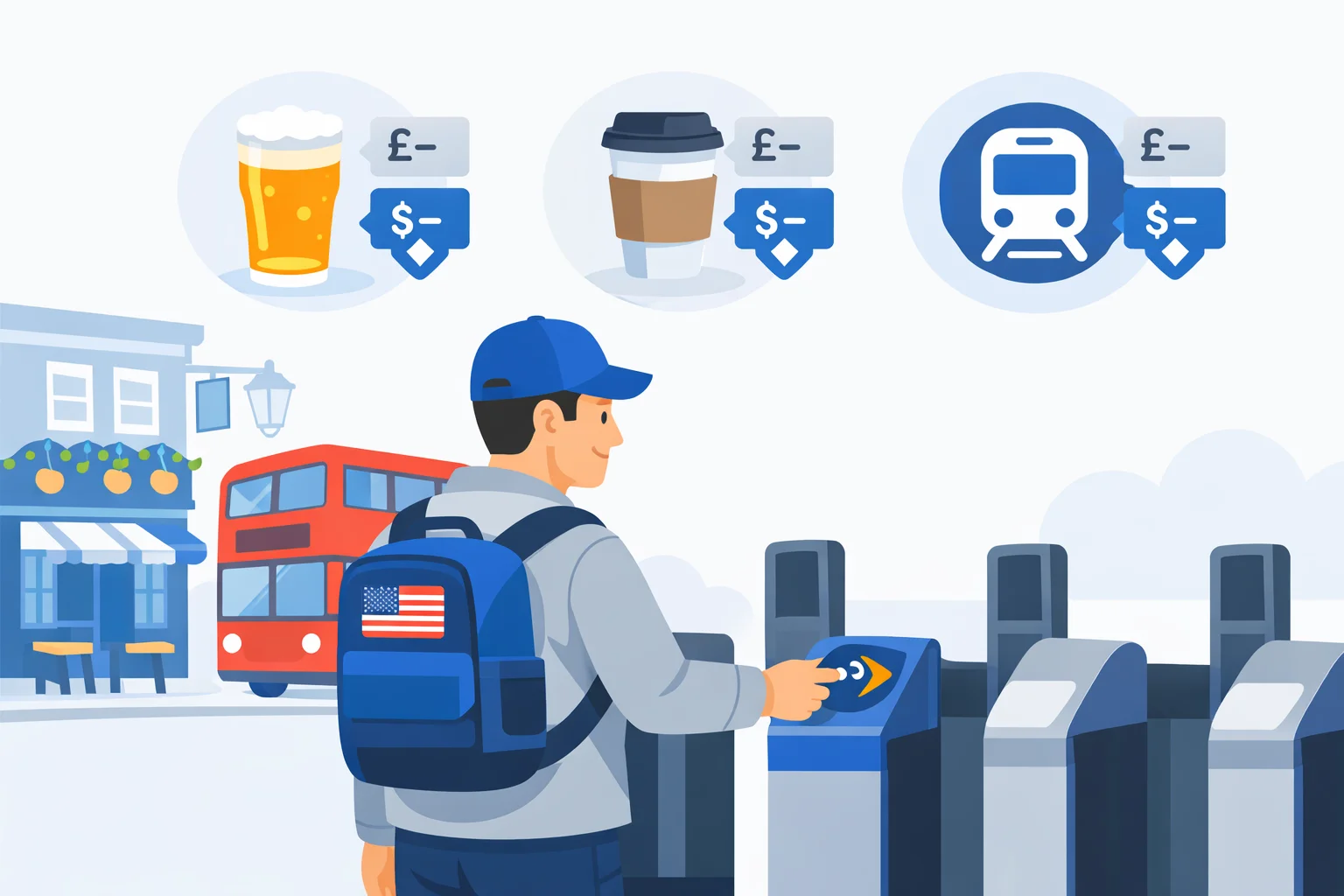
£6.50 Isn't $6.50: The Head-Math That Works
You'll do two different sums in Britain, and it helps to keep them straight. Planning your budget runs dollars into pounds: divide by about 1.27, or multiply by 0.79. So $500 ÷ 1.2715 ≈ £393, and $2,000 ≈ £1,573. Reading a price tag runs the other way — pounds into dollars — and there you multiply by 1.27.
The fast street trick for tags: a pound price is roughly a quarter more in dollars, so add 25% and round up. A £40 dinner-for-two lands near $50 that way, and the exact figure is $50.86. A £6.50 pint becomes $8.13 by the shortcut versus $8.26 exact — close enough to know whether to order another. The mistake that stings is treating the digits as equal: a £4 coffee feels like a $4 coffee, but it's really $5.09. Across a week of coffees, cabs, and pub rounds, that hidden 27% is the difference between your budget holding and blowing through it.
Just Tap: Contactless and the Daily Cap
Here's the single most useful money fact in London, and most first-time visitors miss it: you don't need an Oyster card, a paper ticket, or a Travelcard. Tap the same contactless US card at every gate and the system charges you pay-as-you-go, then stopsonce your day's fares hit the Zones 1-2 cap of £8.90 — about $11.32. Everything after that is free until the small hours.
The arithmetic is friendlier than a day pass. Off-peak singles run £2.80, so three trips cost £8.40 and a fourth would push you to £11.20 — except the cap catches it at £8.90, and trips five and six that evening cost nothing. At peak fares of £3.40 you reach the cap even sooner, on the third journey. The slider in the tool above shows exactly when your day tips into free travel. Two catches worth knowing: each traveler needs their own card (you can't tap two people through on one), and buses run on a separate, lower cap of £5.25 with a flat £1.75 "Hopper" fare that lets you change buses free within an hour.
Cards Rule, But Keep a Little Cash
Britain went card-first years ago. Contactless works on buses, black cabs, market stalls, and corner shops, and plenty of places no longer take cash at all. For most trips a no-foreign-transaction-fee cardis your best exchange rate — it settles within roughly 1% of mid-market, far better than any bureau. That said, carry £50-100 in notes. You'll want it for the occasional cash-only stall at Borough Market, a small tip, a parking meter, or a pub that'd rather not run a £3 card payment.
One quirk trips up American cards: the UK uses chip-and-PIN, and some unattended machines — a few ticket kiosks, self-service petrol pumps, and car-park meters — want a PIN your US card may not have set. Learn your card's PIN before you go, and keep that cash cushion for the machines that refuse a signature. If you're also crossing to the continent, the dollars to euros converter covers the same card-versus-cash calculus for the eurozone.
Getting Pounds Without Getting Fleeced
The worst place to buy pounds is the one that's most convenient: the airport currency desk, which routinely shaves 8-12% off the mid-market rate. On $500 that's $40-60 gone before you've left the terminal. Skip it. When you need cash, pull it from a bank-owned ATM on the LINK network — most are free for a withdrawal — and take out enough in one go to avoid stacking a per-withdrawal fee.
Two traps hide at the cash machine and the checkout. First, the fee-charging standalone ATMs — the yellow Euronet ones near tourist spots — pair a £1.85-£3.50 charge with a rate a few percent worse than a bank's. Second, when any machine or terminal asks whether to charge "in US dollars" or "in pounds," always choose pounds — saying yes to dollars is dynamic currency conversion, a 3-12% markup dressed up as a convenience. For the flip side of this — what your pounds are worth heading home, and how transfer fees work — see the pounds to dollars guide.
Tipping in Britain Is Lower-Stakes
American tipping instincts will overpay in the UK. At a sit-down restaurant the norm is 10-12.5%, not 20% — but before you add anything, read the bill. Many London restaurants already print an "optional service charge" of 12.5%, and tipping on top means paying it twice. On a £60 dinner that's a £7.50 line you might duplicate for no reason. It's perfectly acceptable to ask for that service charge to be removed if the service was poor.
Elsewhere the stakes drop further. You don't tip when ordering at a pub bar — if you want to be generous, you offer to "buy the bartender one." Coffee counters expect nothing beyond the odd coin in a jar. For black cabs and minicabs, rounding up to the nearest pound or two is plenty, and hotel porters take a couple of pounds. Compared with a US night out, where roughly 8% tax and a 20% tip can turn a $50 menu into $64, a £50 UK bill often really is £50.
A London Day, Priced in Dollars
It's easier to hold a budget when you know what the staples actually cost. These are typical central-London prices converted at 1.2715 — your own day will land near this depending on the live rate:
| Everyday item | Price (GBP) | In dollars |
|---|---|---|
| Tube single (Zones 1-2, off-peak) | £2.80 | $3.56 |
| Flat white | £3.30 | $4.20 |
| Black-cab flag-fall | £3.80 | $4.83 |
| Pret-style lunch | £4.50 | $5.72 |
| Pint of lager | £6.50 | $8.26 |
| Pub Sunday roast | £18.00 | $22.89 |
| London Eye (standard) | £29.00 | $36.87 |
| West End stalls seat | £75.00 | $95.36 |
Add it up and a comfortable London day — Tube travel, a coffee, lunch, a couple of pints, and a theatre ticket — sits around £110, or roughly $140, before your hotel. Two people double the food and drink but share the theatre splurge. Keep the price-tag reader in the tool handy: tap "Pint" or "West End seat" and it converts at the live rate, not this frozen snapshot.
Spend the Coins Before You Fly
Leftover British coins are a quiet money leak. Banks and exchange desks outside the UK take only banknotes— never coins — so any £1 and £2 coins in your pocket are worth exactly $0 the moment you clear UK departures. A £2 coin is nearly $2.55 you simply can't redeem. Run them down on your last day: a coffee, a bottle of water, or a snack from the airport newsagent before security.
Even paper money is worth spending or converting deliberately. US banks that buy back pound notes give a poor rate and may charge a fee, so a fistful of £5 and £10 notes brought home can lose 10% or more just sitting in a drawer until your next trip. The clean move is to load a card for nearly everything, pull cash in small deliberate amounts, and aim to touch down back home with almost no sterling left. Charity collection boxes at the airport are a tidy home for the last few coins.
When the Number Above Isn't What You Pay
Treat the converter's figure as an honest baseline, not a receipt. Three things move your real charge. Card fees: many US cards add a 3% foreign-transaction fee, so check yours before the trip — on a $3,000 holiday that's $90 of pure friction. Timing: a card payment settles a day or two after you tap, so you get the settlement-day rate rather than the one on screen when you paid. Markup: any provider that isn't quoting mid-market bakes in a spread, usually 0.5-3%, which is why the reference table above shows the airport-desk version too.
None of it is worth agonizing over on small sums — a one-cent rate wobble is about £8 on a £1,000 budget. Pick a no-fee card, always pay in pounds, use free ATMs sparingly, and you'll land within a cent or two of fair value. If you want the market's view of where this rate is heading, the GBP to USD converter covers what moves the pound, the USD to GBP page digs into transfers and big-ticket buys, and the multi-currency converter lets you pressure-test any exchange desk's markup. For an official daily benchmark, the Federal Reserve's H.10 release publishes the dollar-pound rate, and Transport for London lists the current Tube caps.